

Public sector
Sentra gives a town hall one picture of its streets, car parks and buildings, on the cameras and recorders it already owns. Traffic at the junctions, free spaces in the car parks, vehicles of interest at the barrier, the parks after hours and the public buildings during the day, in one console for the local police and the dispatch desk. Footage stays on a server the institution owns or in an isolated tenant hosted by Sentra in Romania, and every view is written to the audit trail.
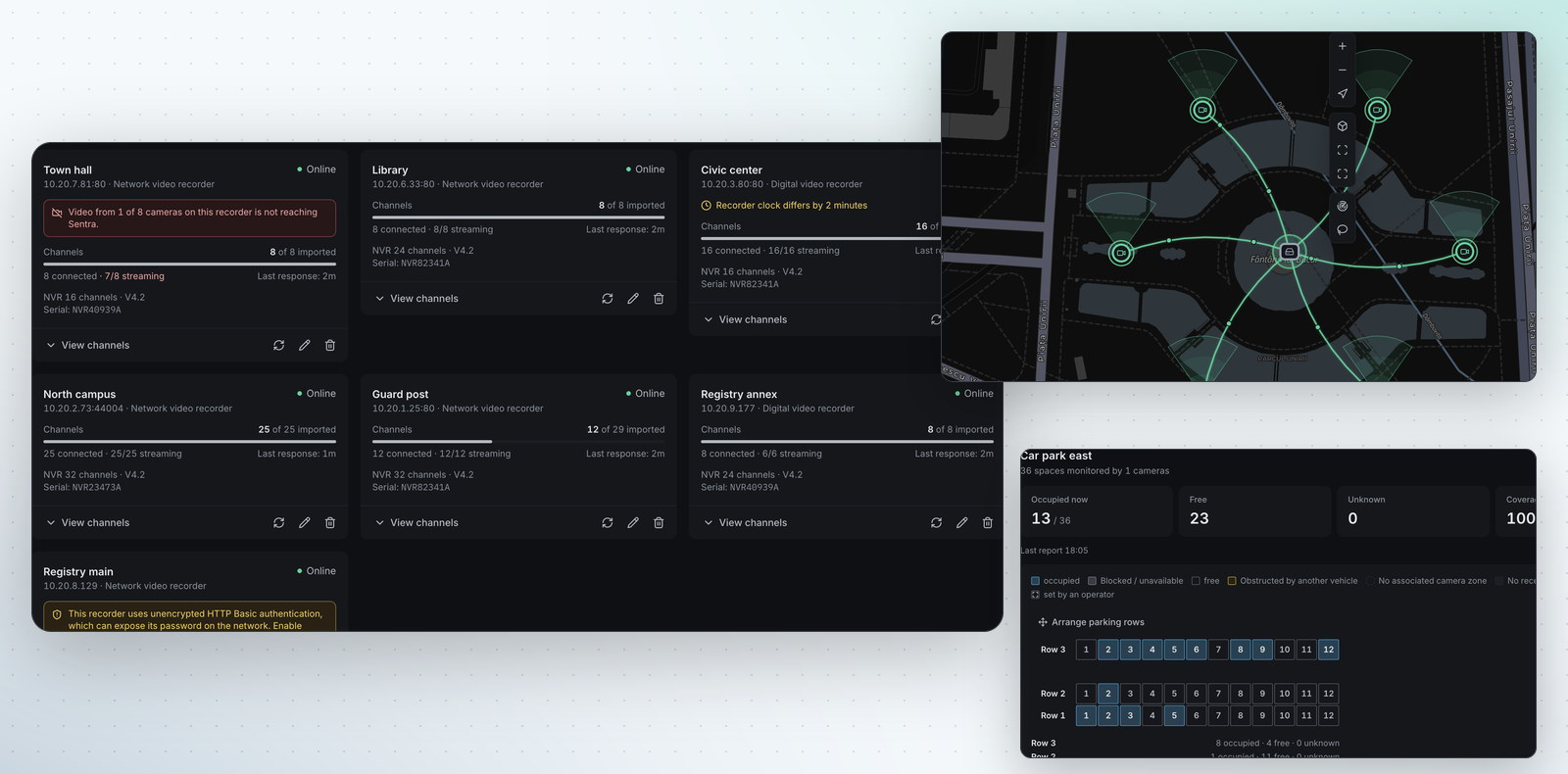
Self hosted on the institution's server, or hosted by Sentra in an isolated tenant in Romania.
Sign in through OpenID Connect, one role per person and an optional camera list.
Views, exports and setting changes recorded, including refused attempts.
The engine works on objects, counts and events, not on identities.
A day at the town hall
The same cameras, sensors and rules from the first shift to the night. All use cases
- 08:00Sign in
Local police staff sign in with their own accounts and see the cameras of their district, from the town's recorders and from the street cameras.
Security - 10:30Car park
The allowed list opens the town hall barrier for staff and residents' vehicles; the rest is logged with a picture.
Access Control - 12:15Schools
A sensor in a school toilet detects vaping. The event arrives in the same inbox as the cameras, with no camera in the room.
Sensors - 15:00Inquiry
The police ask for footage: an evidence package leaves with the reason recorded and verifies outside the platform.
Recordings and Evidence - 17:00Report
The weekly report with the counts per junction and the car park occupancy goes to the mayor's office by email.
Reports and Audit
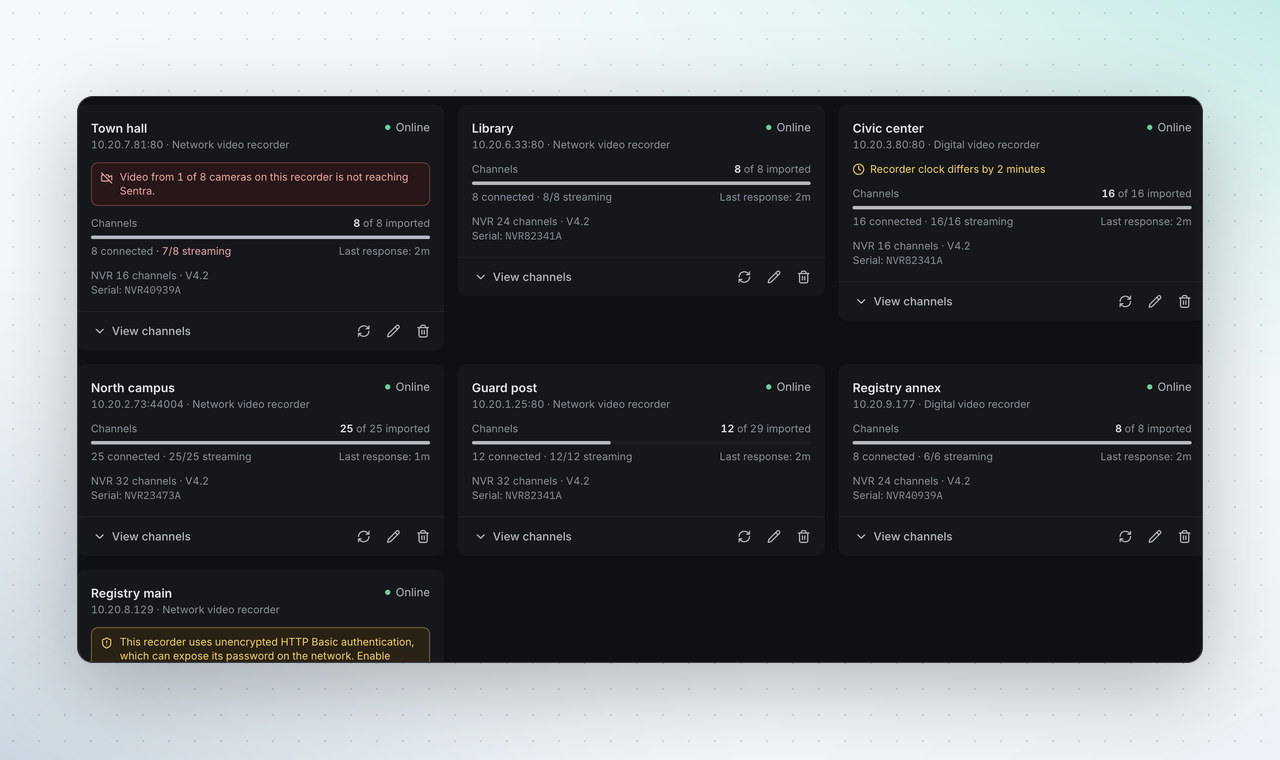
The recorders the town already owns
Most institutions already have a recorder in each building: the town hall, the library, the civic center, the registry. Sentra connects to those recorders and shows their channels in the same console as the street cameras, with the state of each recorder, its disks and its retention.
Each building sits on the map with its recorder and its cameras, so a camera that goes dark or a recorder that fills up is seen the same day, not at the next audit.
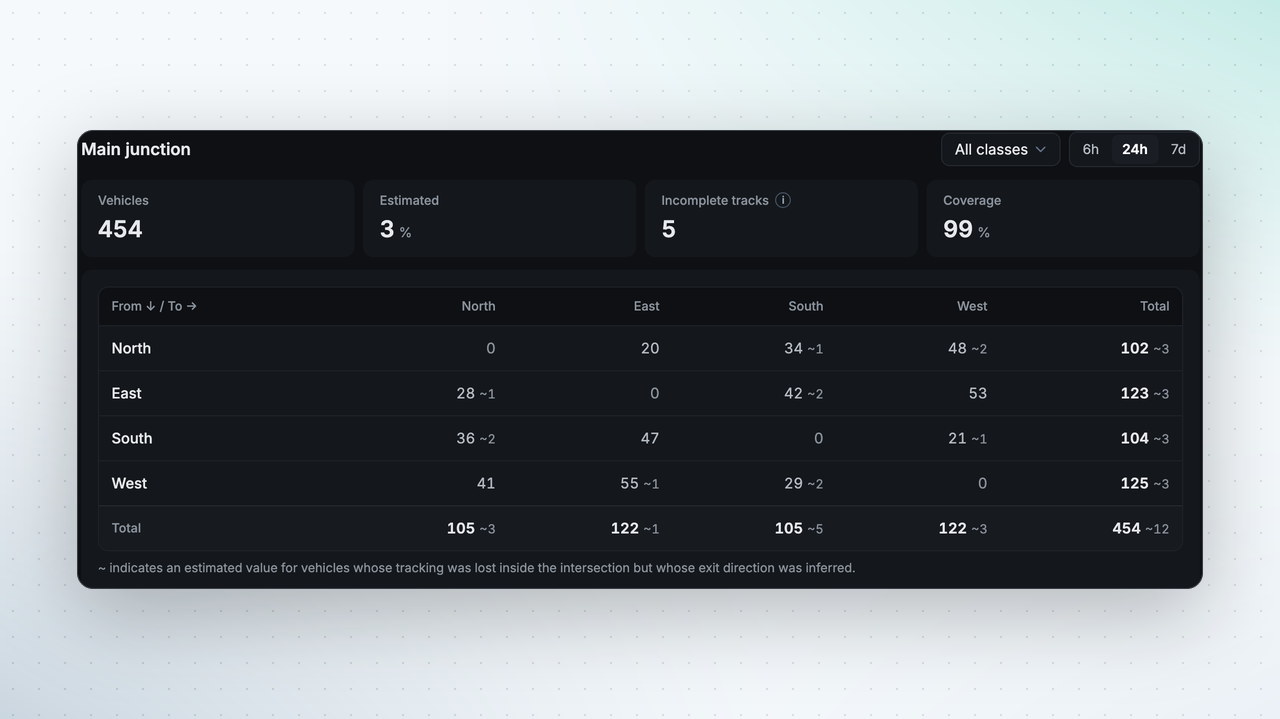
Traffic at the junctions
Street cameras at the junctions count vehicles per approach and per turn, around the clock, with the hour by hour pattern of the day. The figures feed the traffic study, the argument for a new roundabout and the check after a scheme is changed.
- Counts per approach and per class: cars, large vehicles, two wheelers
- Before and after a change to the junction, from the same camera
- Exported as a table or sent as a scheduled report
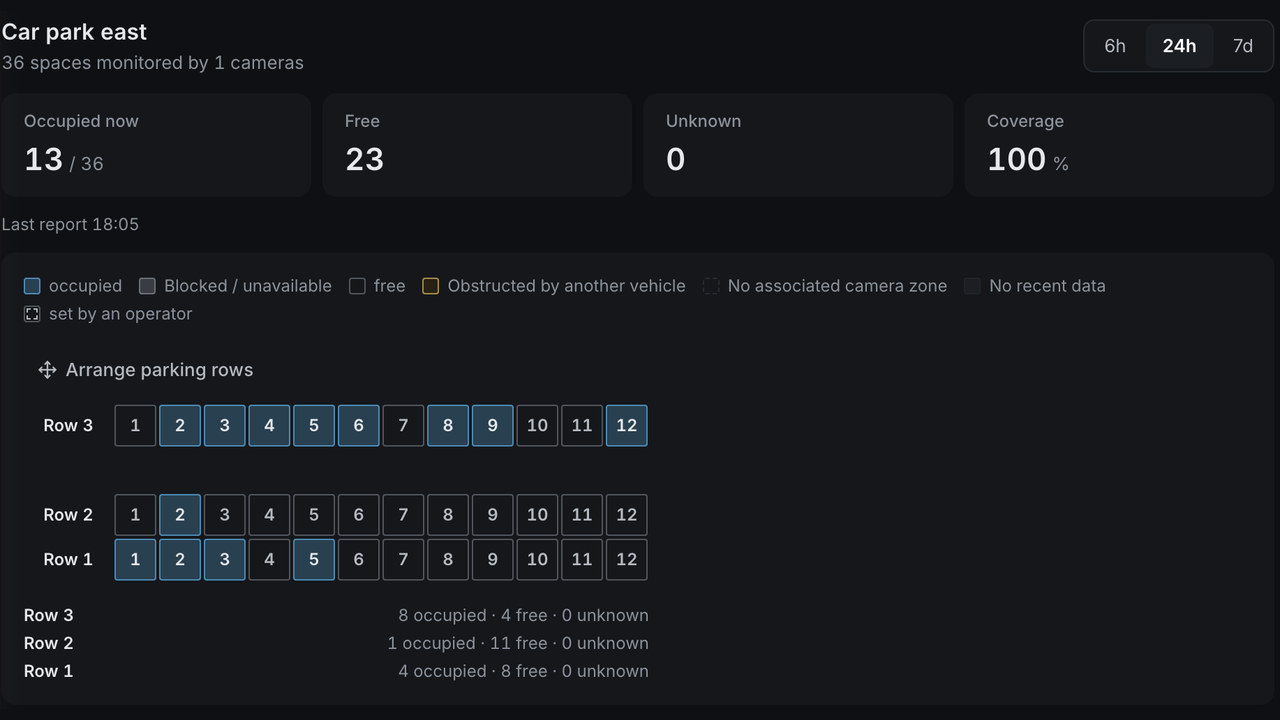
Parking and public space
A camera over a car park knows which bays are free, which row is full and how long cars stay; a counting line at the entrance knows how many are inside. The town sees occupancy across its car parks on one board and can show it to residents.
In squares and parks, heatmaps show where people gather and when, for the market days, the events and the cleaning plan.
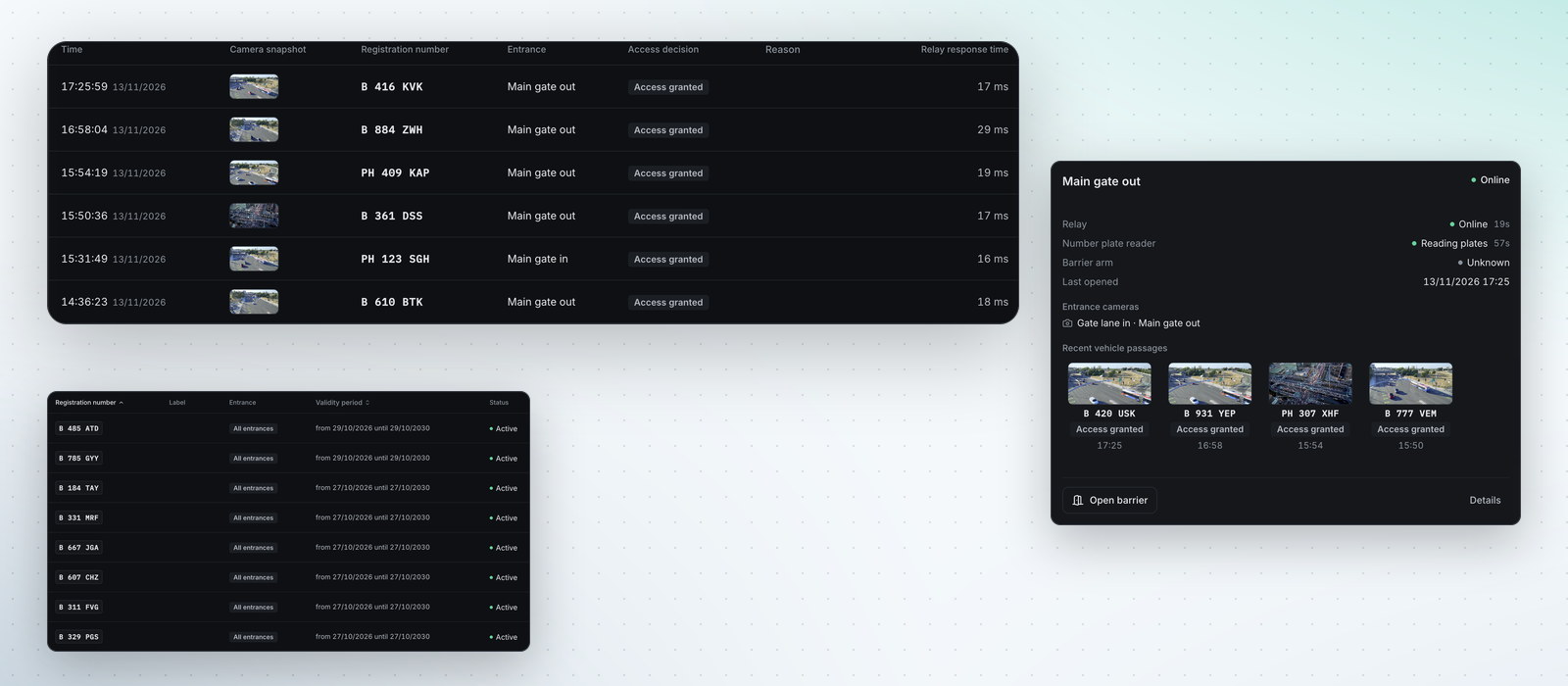
Vehicles of interest and the institution's barrier
Plates read on the street cameras are matched against a watchlist: a stolen car, a vehicle under a court order, a known offender's car. The alert reaches the local police with the picture and the camera, and the route of the vehicle across the town can be followed on the map.
At the town hall and the depot, the barrier opens for the vehicles on the list, logs every passage with a picture, and keeps a manual open for the guard.
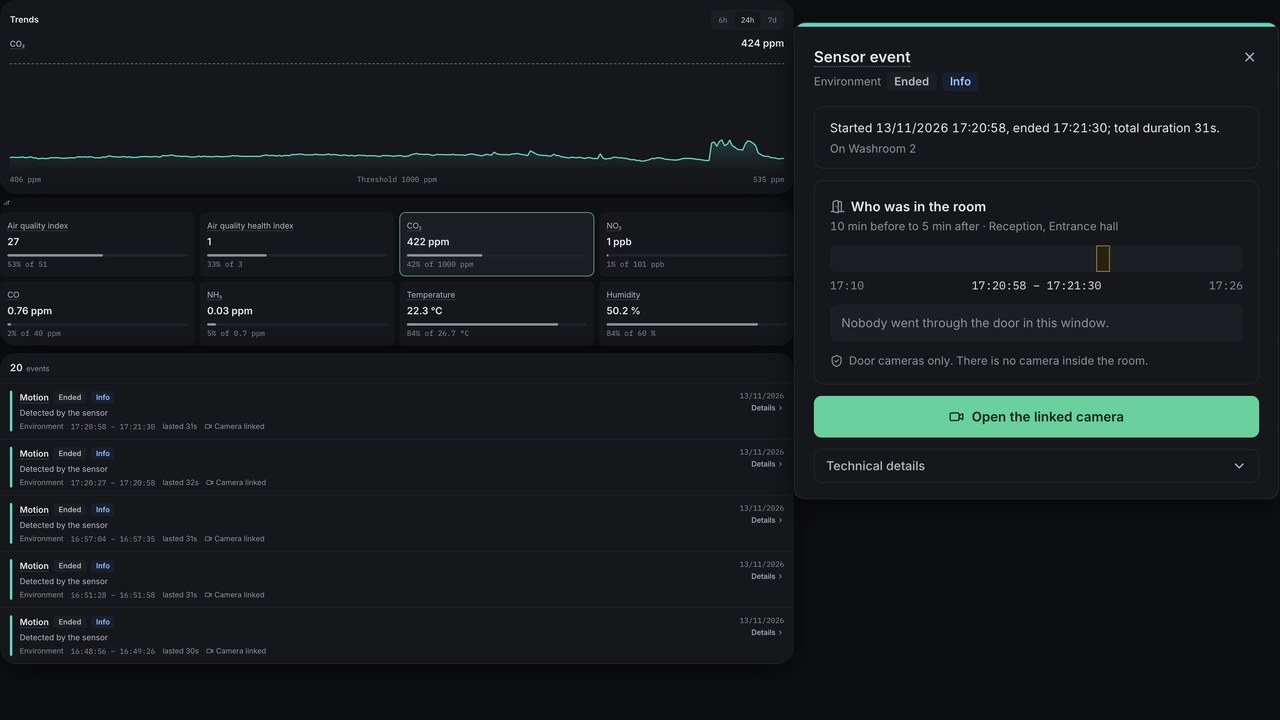
Schools and public buildings
Where a camera is not allowed, a sensor does the work: vaping, smoke, aggression, a call for help or a broken device in school toilets, locker rooms and waiting rooms. The event lands in the same inbox as the cameras, and the cameras that see the door show who went in before it and who came out after it.
Entrances, corridors and halls of public buildings keep their cameras, with alerts for intrusion after hours and for crowding during the day.
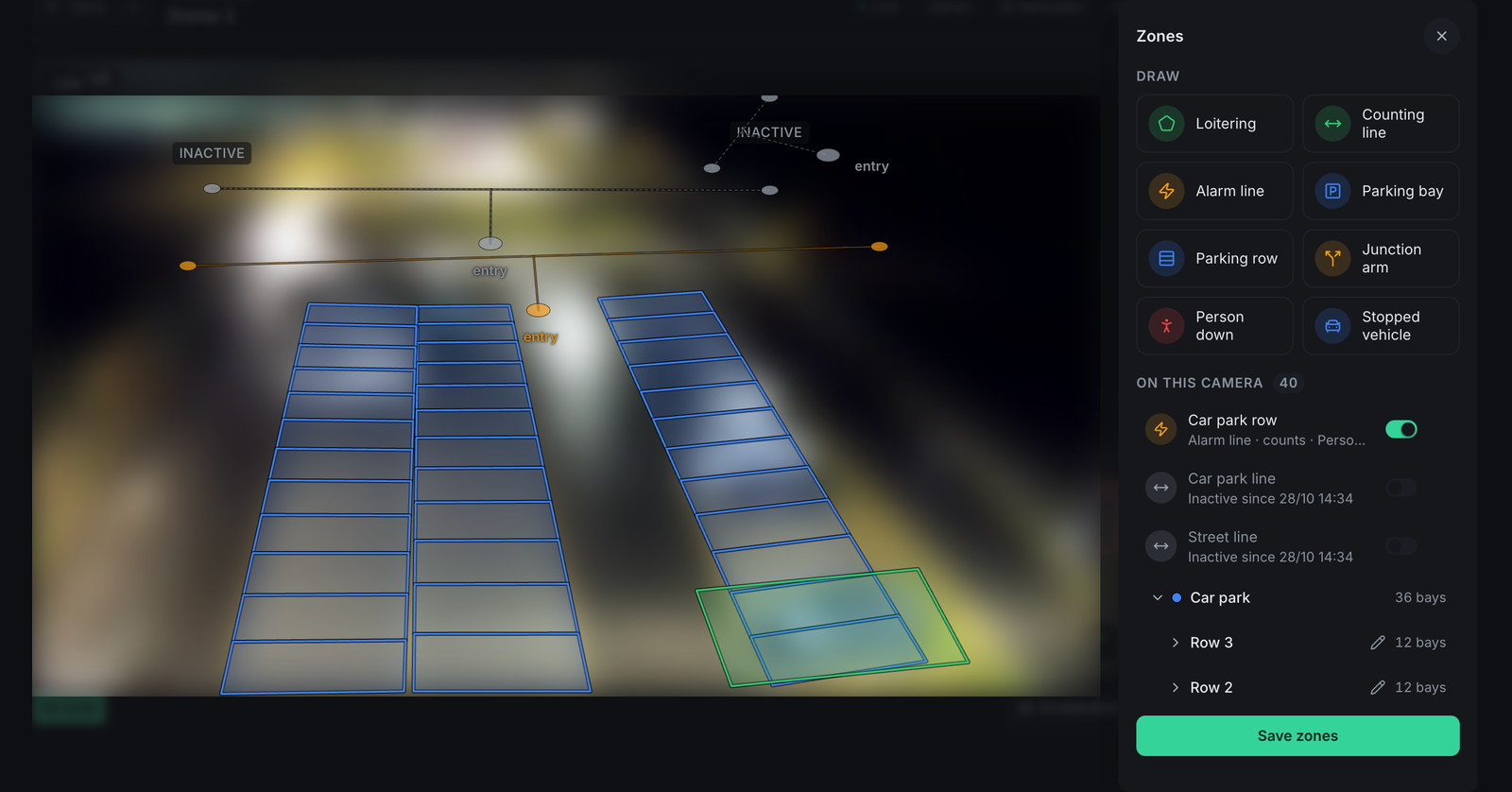
Parks after hours, dumped waste, the fence line
Zones drawn on the camera picture raise an alert when someone stays in a park after closing, when a vehicle stops where it should not, or when waste is dumped at a container point. Smart rules tie the pieces together: the same vehicle seen at two sites in an hour, a person down with nobody around, a gate left open.
Every rule is tested on the last weeks before it is switched on, so the local police gets the alerts that matter and not a flood.
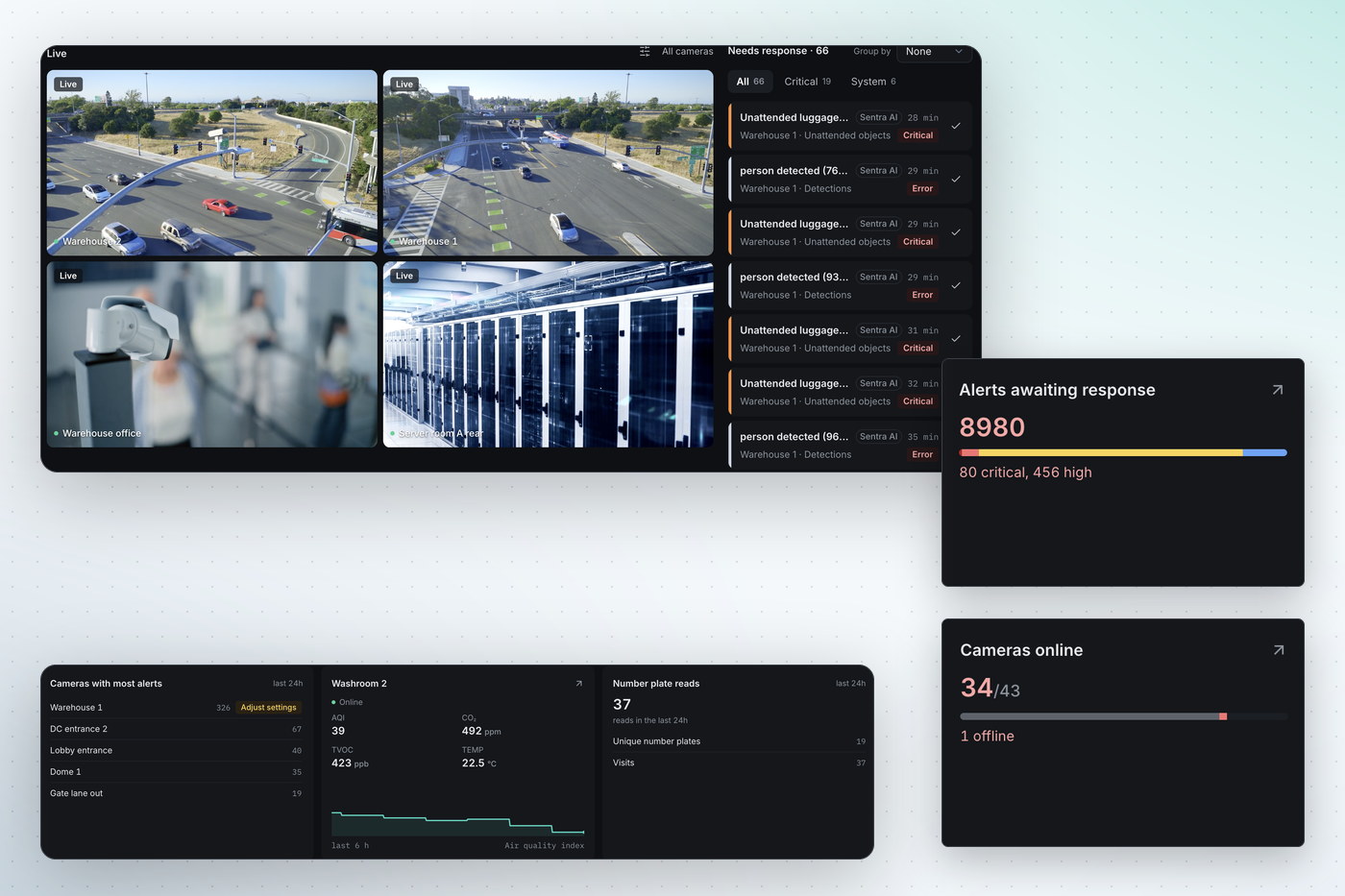
The dispatch desk
The dispatcher works from one dashboard: the live cameras of the moment, the alerts that need a response, the map of the town with every device and its state, and the last 24 hours replayed place by place at the start of a shift.
At each shift change the platform writes the handover: what happened, what is still open, which cameras went down, with a note for the next shift, emailed as a PDF.
Evidence for the police, a record for the data protection officer
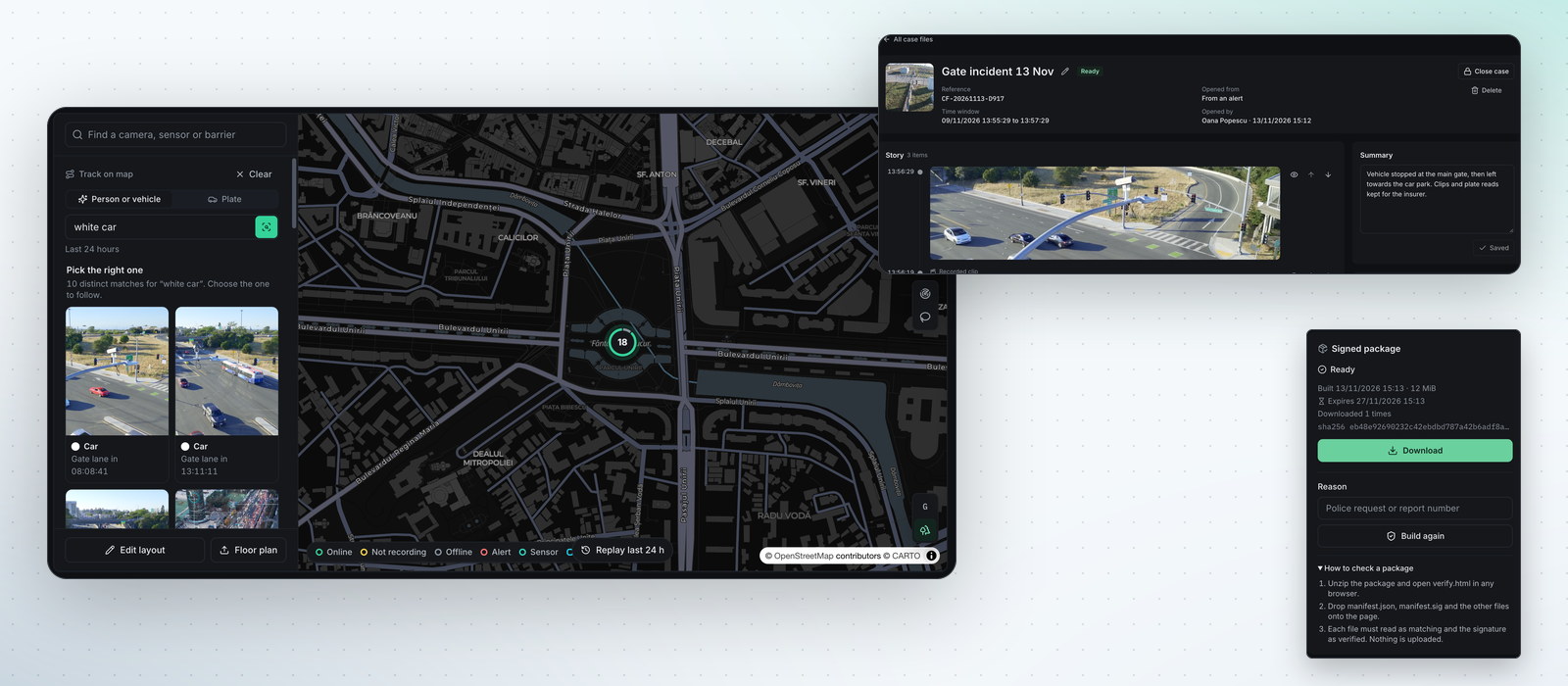
An inquiry starts from a sighting and becomes a case file: the route across cameras, the clips around each stop, the plate reads and the sensor events, in time order, with a summary. The case leaves as a signed package that verifies outside the platform, with the reason recorded.
Every view, export and change is in the audit trail, retention is enforced per camera, and no face is identified: the platform works on objects, counts and events.
Capabilities on this page: Map, Parking and Junctions, Counting, Heatmaps, Access Control, Sensors, Zones and Rules, Live Video and Videowalls, Assistant and Shift Handover, Investigations, Reports and Audit.
See it on your own cameras
A demo can run on your cameras or on a Sentra demo site, self hosted or hosted by Sentra. Tell us which events and figures you need, and we prepare it.